
When does a discount become deceptive? An economic framework for the regulation of reference pricing
The use of ‘reference’ pricing—where a previous (or future) ‘was’ price is displayed alongside the current ‘now’ price to indicate a discount for customers—is a common feature across digital and physical markets. In supermarkets, retailers commonly advertise a headline Recommended Retail Price (RRP), or ‘was’ price, alongside the current discounted price, with similar practices in online marketplaces.
Reference prices can serve as a useful cue for consumers to understand the value of a current offer, helping customers to assess if the current price reflects a good deal. This can support good outcomes for consumers and reflects healthy market dynamics in a competitive market. However, in recent years, regulators have become increasingly concerned that reference prices may be used deceptively to mislead consumers and weaken competition.
In particular, a firm may advertise an artificially high initial price for a product over a short period of time, with the expectation of achieving only a small number of sales at this initial price, but with the intention of making the future discounted price appear to be better value than it truly is.
As we discuss below, the regulatory framework governing reference pricing continues to evolve. The question of what constitutes an acceptable reference pricing practice has recently been brought into focus by proceedings between the UK’s Competition and Markets Authority (CMA) and mattress retailer Emma Sleep, with a full trial on the retailer’s use of reference pricing commencing in June 2026.1 In the context of that case, the CMA has set out the following two conditions that it considers must be satisfied for a ‘was/now’ price comparison to be regarded as genuine:
- The duration requirement—the ‘now’ price must not be offered for longer than the original ‘was’ price.2
- The volume requirement—at least one unit must be sold at the ‘was’ price for every two units sold at the ‘now’ price.3 That is, the ‘sales ratio’ must be less than 2:1 in terms of sales at the discounted price compared with the headline price.
These conditions may be intuitively appealing: a reference price that was on offer only briefly, or at which almost nothing was sold, is difficult to characterise as a genuine market price. However, the economic foundations of these specific requirements—including the question of how the parameters should be calibrated across different market contexts in a way that is effective, proportionate and mitigates potential unintended consequences—remain unexplored. Indeed, the 2:1 sales ratio may be appropriate for some market contexts, but poorly suited to others.
Below, we set out a fundamental economic framework as a first step towards answering these questions.
Reference pricing—what’s the harm?
Misleading reference practices can potentially harm consumers and competition in several ways. Consumers may incorrectly infer the quality and value of a product from the reference price, leading them to overestimate the quality and the true value of the current offer.4 As a result, consumers may not shop around for alternative suppliers offering a similar product, which could provide higher value based on the customer’s needs or be available at a lower price. This also makes it more difficult for a firm’s rivals to attract customers to consider their products, reducing the incentives for the discounting firm to compete to retain customers and weakening competition. Customers may also buy products that they would not otherwise have purchased.
There may also be a deeper concern about the distortion of competitive signals across the market. When a firm inflates its reference price, it risks distorting consumers’ broader perception of what constitutes a fair or normal price for a product or service. This can confer a competitive advantage on firms willing to engage in deceptive practices relative to those that price honestly. This creates a ‘race to the bottom’ in which transparent, stable pricing may become a commercial disadvantage. Over time, if reference pricing becomes widespread, it may also erode the informational content of prices across the market as a whole.
However, the potential for consumer harm to arise in practice may vary based on the nature of the product. For example, where a consumer purchases a product regularly, they may have a better understanding of the true value of the product, reducing the potential for them to be misled. Furthermore, where a firm advertises discounts regularly, consumers may learn that the advertised references do not provide a meaningful indication of the true value of the product, reducing the impact on the choices that customers make.
Considering this, what—if any—regulatory intervention may be needed to ensure reference prices remain meaningful signals of value to consumers?
Is there an economic case for regulatory intervention?
Where any significant intervention in a market is proposed, it is good practice to put forward a case for change based on a robust understanding of how the market is currently functioning and with the identification of one or more ‘market failures’. The presence of a market failure means that a free market may not lead to socially optimal outcomes.
Where poor outcomes for consumers (and competition) due to market failures are identified, there can be a justification for regulatory intervention.
In the context of reference pricing, two market failures are particularly relevant.
- The first is asymmetric information: when a firm sets an artificially high reference price, the sellers know that the ‘was’ price does not reflect the true value of the product, but the consumer does not. Therefore, consumers cannot make fully informed decisions about whether an offer represents genuine value.
- The second is rooted in behavioural economics. Even where consumers have access to relevant information, they may not always behave as perfectly rational decision-makers. Research on anchoring bias shows that an initial price can act as a reference point that systematically shapes consumers’ subsequent judgements of value. Salience bias compounds this effect: prominently displayed savings figures attract disproportionately large weight in consumers’ decision-making, making it harder for consumers to focus on the absolute price or compare it objectively with alternatives. Together, these biases mean that consumer harm can arise even in markets where information is, in principle, available.
It is, however, well-established that any form of regulatory intervention—particularly when not well-designed or justified—may risk a distortion of healthy market forces, and can result in unintended consequences. Therefore, prior to any intervention, a thorough assessment should be developed to assess how the proposed remedy would address the identified market failure. It should also consider a range of potential policy options and select the option that is both proportionate to the harm identified and least distorts the competitive process. The analysis should also consider the extent to which the market could address any potential market frictions over time.
Reference pricing in the regulatory spotlight
Regulators internationally have contended with the tricky question of how or whether to intervene to control the use of reference pricing, some examples of which are provided below.
- The Netherlands Authority for Consumers and Markets (ACM) published guidelines in 2025 which require that reference prices must refer to the lowest price offered by a retailer in the 30 days preceding the price reduction. Discount periods must also not be ‘excessively long’ with respect to full price periods (and should never exceed three months).5
- The Australian Competition & Consumer Commission prohibits the use of misleading ‘was’ prices with reference to qualitative benchmarks. For example, ‘was’ prices which did not exist for a ‘reasonable period’ prior to a discount, or those at which ‘only a very small proportion’ of sales were made are banned.6
The CMA’s proposed approach to reference pricing comes alongside a broader increase in regulatory scrutiny of pricing and commercial practices. Since 6 April 2025, the CMA’s consumer protection regime was strengthened through the introduction of the Digital Markets, Competition and Consumers Act (DMCCA)—providing the CMA with direct enforcement powers without requiring court referral, aligning consumer protection law powers with competition law. The Authority can directly impose fines of up to 10% of global turnover and apply consumer redress.
The DMCCA defines two types of prohibited practices: 32 banned practices, which are considered to always breach the law, and practices that are considered to be unfair only if they are likely to cause the ‘average consumer’ to take a ‘transactional decision’ they would not otherwise have taken.
The regulations include a strengthening of the legislation on reference pricing, where the following is defined as a banned practice:
falsely stating that a product will only be available for a limited time, or that it will only be available on particular terms for a limited time, in order to elicit an immediate decision and deprive consumers of sufficient opportunity or time to make an informed choice.7
Several cases have tested the regulator’s approach to reference pricing in the UK.
- The CMA’s 2015 response to a super-complaint on pricing and promotional practices by consumer group Which? questioned the appropriateness of supermarkets using reference prices which are ‘significantly’ outlasted by promotional prices.8
- A previous Office of Fair Trading (OFT) investigation into furniture and carpet retailers stated it would question reference prices unless retailers had sold a ‘significant number of units’ at a reference price, relative to a discounted price.9
These standards represent qualitative principles rather than precise thresholds, such as the volume and duration requirements that the CMA has defined in the context of its case against mattress retailers.
The case between the CMA and Emma Sleep predates the CMA’s strengthened powers under the DMCCA which explains why the case needed to be referred to the High Court. However, the outcome of this case is expected to set the precedent for how the CMA will approach these types of cases moving forwards.10
An economic framework for assessing the CMA’s proposed volume and duration requirements on reference pricing
A simple supply and demand framework can help to understand the potential impacts of the CMA’s proposed measures, and reveal important considerations for how the requirements should be calibrated across different markets. Put simply, this workhorse model tells us how the amount of a product that consumers are willing to buy and the amount that firms are willing to sell will vary based on the price.
On the consumer side, the demand curve is usually downward sloping, which reflects the principle that consumers will typically purchase more of a product over a given period of time (e.g. one month) as the price is discounted. However, the specific slope of the demand curve—and therefore the extent to which demand will rise in response to the discount—will depend on many factors, including:
- how sensitive consumers are to the price when considering purchasing a particular product;
- the extent to which a firm’s product is considered to be an equivalent substitute to its competitors, or highly differentiated;
- the level of the initial ‘headline’ price and the magnitude of the discount;
- seasonal variations in demand.
As the CMA’s proposed volume and duration regulations place a direct restriction on the sales that a firm is able to complete during a ‘discounting’ period, these factors will have important implications for the calibration of the regulations. We discuss each of these factors in turn.
How sensitive are consumers to price changes for a product?
In some markets, consumers are highly sensitive to price, and small discounts on price will generate a significant increase in sales. In other markets, such as for petrol and diesel for cars, demand is relatively ‘inelastic’—i.e. we tend not to drive additional journeys and use more fuel in response to a small decrease in the price on the forecourt.
This means that the CMA’s proposed volume requirement—whereby the sales at the discounted price cannot exceed a ratio of 2:1 compared with the headline price—will become more restrictive on firms operating in markets where consumers are more sensitive to price changes. Intuitively, in markets where the total increase in consumer sales increases by a larger amount, the firm will more quickly exceed this ratio.
Furthermore, the CMA’s volume requirement means that firms must have sufficient information regarding the extent to which demand for a product will respond to movements in price in order to ensure that the proposed regulations are not breached. Indeed, if customers respond to a discount by purchasing more additional units of a product than the firm expects, this could lead to a firm breaching the requirement, or mitigating this outcome by, for example, ending the discount period early.
We illustrate the key principles in the box below.
The CMA’s regulations will be more restrictive in markets where consumers are more responsive to price discounts
The figures below reflect the demand curve for two different markets. The figure on the left reflects a market where consumers tend not to respond significantly when a price is discounted—which economists term a ‘low elasticity’ or ‘inelastic’ demand curve. The figure on the right reflects a market where demand is more elastic, or equivalently, consumers are more sensitive to price.
In both markets, the headline price is £1,000, which results in total sales of 1,000 units per month. However, when the price is discounted to £500, sales increase to 1,400 units per month for the inelastic market product while increasing to 3,500 units in the elastic market.
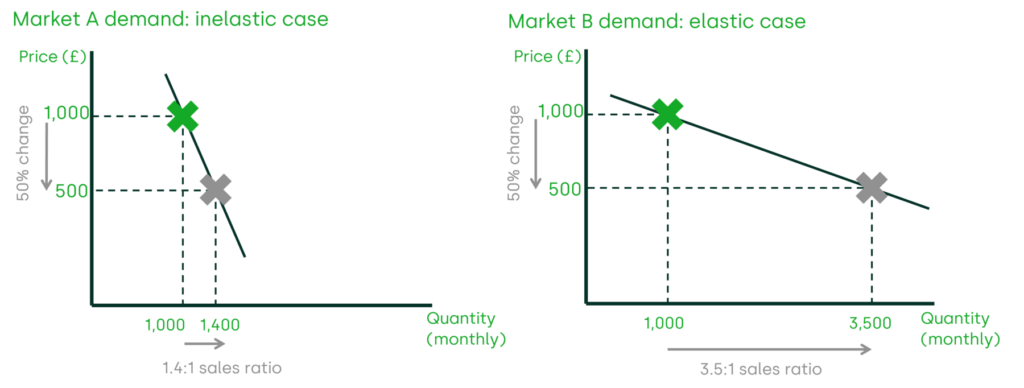
As the CMA’s volume regulation imposes a 2:1 ratio limit between sales at the discounted price and sales at the headline price, whether the pricing strategy constitutes a breach will differ across these two markets. In market A, the strategy yields a 1.4:1 sales ratio, within the CMA’s requirements, while in market B, the same price discount generates a 3.5:1 sales ratio—nearly double the sales permitted by the CMA.
Source: Oxera.
How closely do competing products substitute for one another?
The analysis above compares the sensitivity of the total market demand for a product to movements in the market price. If the market consists of only a single supplier, i.e. a monopoly, then the firm’s own demand curve is equivalent to the market demand curve. However, in competitive markets with many sellers, the demand for a firm’s product will generally be more sensitive to changes in the price than the market demand curve. That is, if a firm decreases its price below its rivals, then its sales would be expected to increase. While some of these sales may come from customers who were not previously willing to buy as many units of the product at the old price (i.e. increasing the total sales in the market for a product), some of these sales will come from attracting customers away from their now relatively more expensive rivals.
The extent to which consumers will switch to a seller that offers a discounted price will depend on whether consumers consider the products to be close substitutes.
In highly competitive markets where firms offer minimally differentiated products (such as petrol for cars), a small reduction in price can generate a large increase in sales. Indeed, consumers’ willingness to switch suppliers for small savings in price is a key driver of competition among retailers, which can deliver lower prices for consumers. In markets where there exists strong brand preferences, or where firms offer highly differentiated products, consumers will be less likely to switch.
There are three key implications for the calibration of the CMA’s volume requirement.
First, in markets where firms offer minimally differentiated products, and where consumers are engaged and switch quickly to a firm offering a better deal, these firms will more quickly find that their use of reference pricing and discounting will breach the CMA’s volume requirement.
Second, in markets where there are many sellers of similar products, as in the benchmark ‘perfectly competitive’ market, each firm may hold only a small market share when firms charge the same (competitive) market price. However, a small decrease in price can generate a relatively large increase in sales for a discounting firm, which would quickly increase their sales and breach the CMA’s proposed volume requirement.
Third, if one firm introduces a discount in an attempt to drive up sales—which can reflect healthy market dynamics and deliver good outcomes for consumers—whether the firm’s pricing strategy will breach the CMA’s regulations will depend on the price response of its competitors.11 Where a firm’s competitors quickly discount their price in response, the extent to which the initial discounter would be able to steal customers away from its rivals would be lower, reducing the likelihood of breaching the CMA’s volume requirement.
This generates an unusual outcome: compliance with the CMA’s proposed volume requirement depends not only on a firm’s own pricing decisions, but on the behaviour of its competitors—that is, does a firm’s rivals respond with their own discount?
We illustrate the key principles in the box below.
The CMA’s regulations will be more restrictive in markets where product differentiation is lower
Consider a market with many sellers where the demand is highly inelastic—that is, when all firms discount their products, the total sales of the product in the market increase by only a small amount as shown in the figure on the left. However, each firm is offering a similar product, which means that the demand for the individual firm’s product is highly elastic because consumers are willing to switch to the cheapest supplier, as shown in the figure on the right.
The initial market price charged by all firms in the market is £1,000, resulting in total sales of 1,000 units of the product per month. As there are many firms selling similar products at the same price, the individual retailer only secures sales of ten units per month. To drive up sales, the retailer offers a discount below the market price offered by other sellers to £800. As a result, many consumers switch to purchasing from the discounting firm—and its total sales increase from ten to 400 units per month.
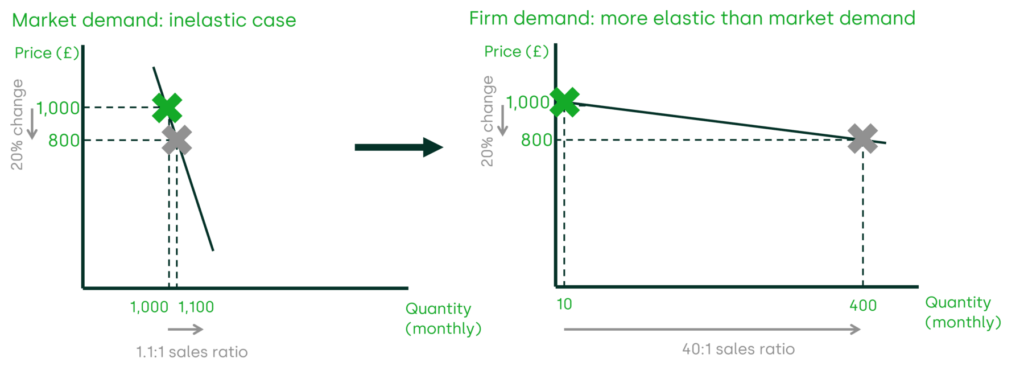
Therefore, the more elastic (i.e. more horizontal) the demand curve for an individual firm, the larger the increase in the number of sales following any discount in price and the more quickly a firm’s discounting practice would breach the CMA’s requirements.
Note: The increase in sales for the individual firm of 390 units exceeds the total additional 100 sales generated by the discount because the firm also attracts sales away from its competitors—increasing its market share from 1% (10/1000) to 36% (400/1100).
Source: Oxera.
The level of the initial ‘headline’ price and the magnitude of the discount
Whether a firm’s use of reference pricing and discounting will comply with the CMA’s volume requirement depends not only on the size of the discount, but on the level at which the headline price was originally set.
When the initial price is high—and consequently the quantity sold at that price is low—even a moderate discount can produce a large increase in sales relative to the sales at the original price, generating a high sales ratio. The same discount applied from a lower starting price will tend to produce a smaller sales ratio, because more units were already being sold at the headline price.
In this sense, the volume requirement may be aligned with the CMA’s objective: it bites hardest where the headline price appears to be most artificially inflated. A firm that sets a very high price at which few consumers are willing to buy, and then discounts sharply to drive a large volume of sales, may be exhibiting exactly the pattern that the CMA seeks to prevent.
However, this feature also generates some less straightforward consequences. A firm wishing to offer a large discount from a genuinely high price—for example, a premium retailer running an end-of-season clearance—may find itself constrained by the rule in ways that have nothing to do with deception. Similarly, new entrants and smaller firms, which may operate at higher unit prices and lower sales volumes before establishing a customer base, may find that discounting strategies they rely upon to compete and grow are more tightly restricted than those available to larger, established rivals already operating at higher volumes.
The volume requirement is therefore not neutral across markets and the stage of a firm’s development—a consideration that regulators and courts may need to weigh carefully when designing, implementing and enforcing the rule across different market contexts. Similarly, the magnitude of the discount will also play a role in determining whether a price reduction is likely to generate sufficient sales to breach the CMA’s 2:1 threshold. Intuitively, larger price cuts will, all else equal, usually generate larger increases in sales for a firm—making it more likely that the strategy will breach the CMA’s volume requirement.
We set out further technical details in the box below.
The volume requirement will be more restrictive where sales at the headline price are relatively low
The effect of the initial price level on the sales ratio can be illustrated using a simple linear demand curve, where the quantity sold increases steadily as the price falls.
Suppose a firm reduces its headline price by £250. If the starting price is £1,000, at which only 400 units per month are sold, a reduction to £750 increases monthly sales to 1,000 units. The ratio of discounted-price sales to headline-price sales is 2.5:1, breaching the CMA’s threshold.
Suppose the same £250 discount is applied from a lower starting price of £750—at which 1,000 units per month are already being sold. The reduction to £500 increases monthly sales to 1,600 units, yielding a ratio of 1.6:1—within the permitted range.
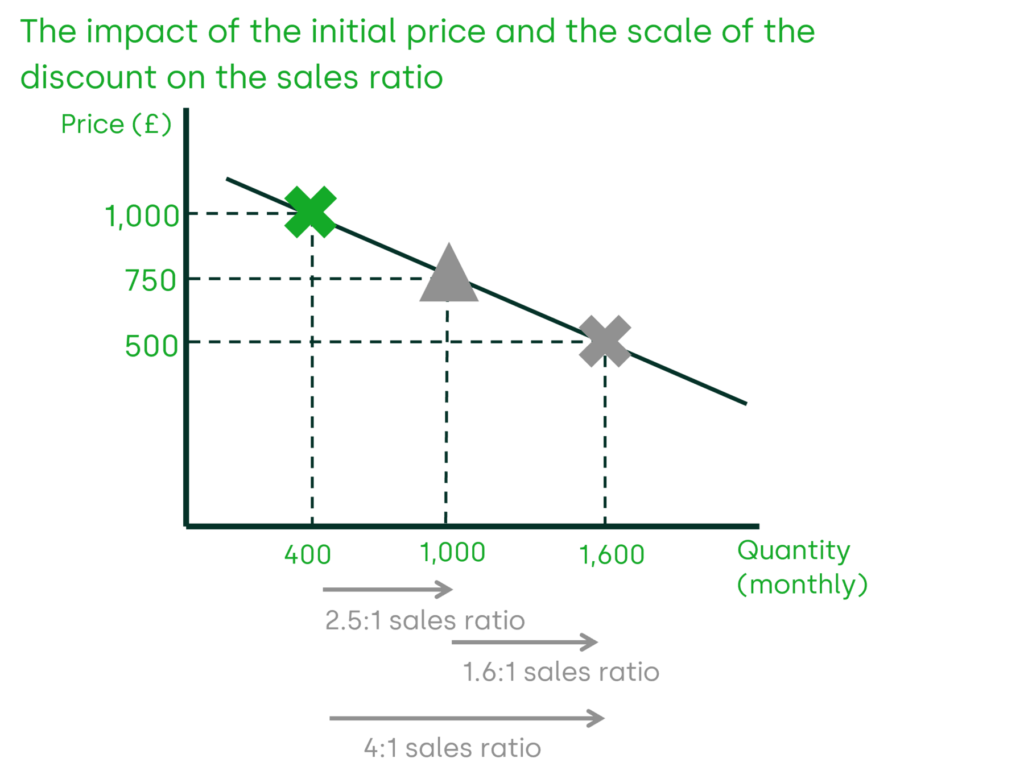
Therefore, the same absolute discount, even producing the same absolute increase in sales, can either breach or comply with the volume requirement depending on the level of the headline price. This arises because demand elasticity—the responsiveness of sales to a given price change, measured as a proportion of the original sales—is not constant along a linear demand curve. It is higher at elevated prices, where sales volumes are low, and lower at reduced prices, where sales volumes are already substantial.
Source: Oxera.
Seasonal variations in demand
Many markets exhibit predictable fluctuations in demand across the year, and this has important implications for how the CMA’s volume and duration requirements operate in practice. In markets where sales are naturally concentrated in a short window, firms may face sharply different levels of demand for their product over time, independent of any attempt to mislead consumers through discounting.
Consider the market for Christmas trees. Sales are typically consolidated over a few weeks each year, and firms entering the final stages of that window face a strong incentive to reduce prices in order to clear remaining stock before it becomes unsellable. Such discounts are commercially rational and, from a consumer perspective, can be consistent with delivering good outcomes—benefitting consumers who are willing to wait for a lower price. However, the nature of this market means that a firm offering an initial price during the early peak period, and then discounting sharply as the season draws to a close, may find that the volume of sales at the discounted price substantially exceeds those at the original price. This is not because the reference price was artificially high, but because of the seasonal pattern of demand and the diminishing value of the product.
The duration requirement raises similar considerations. Where a short peak season is followed by a long discounting period—or where a firm reasonably extends a clearance sale beyond the original full-price window—the duration condition may be breached for legitimate commercial reasons.
Similar considerations arise beyond obviously seasonal goods: consumer electronics concentrated around Black Friday, or fashion lines sold predominantly at launch, may present comparable dynamics where the timing and volume of legitimate discounting strain a uniform rule.
We illustrate the key mechanics in the box below.
The CMA’s proposed approach will be more restrictive in markets with seasonal variations in demand
The dynamics of seasonal markets can be illustrated using a simple two-period supply and demand framework, representing an early ‘peak’ period and a later ‘clearance’ period within an overall short seasonal window.
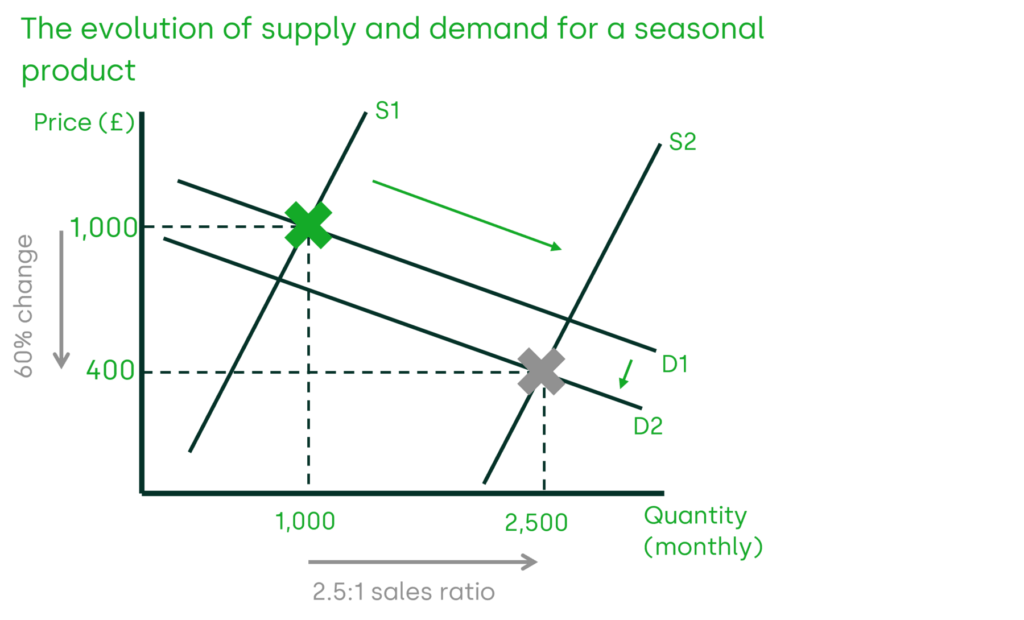
In the initial period, market conditions are stable: supply and demand intersect at a market price of £1,000, and 1,000 units are sold. First, demand shifts inwards (to D2): many consumers who intended to purchase the product have already completed their purchases, reducing the pool of remaining buyers. Formally, at every price level, the quantity demanded by consumers in total is now lower. Second, supply shifts outward to S2: because the good is perishable—with limited opportunity for sales once the season ends—firms are willing to sell at any price above zero to clear remaining stock.
The combined effect of these shifts is a substantial fall in price and a sharp increase in the volume of sales, with total units sold rising to 2,500 in this example. This implies a sales ratio of 2.5:1 between the clearance period and the peak period.
Critically, this outcome arises not from any attempt to manipulate consumer perceptions of value, but from the underlying economics of perishable seasonal supply. Therefore, a volume requirement calibrated without reference to demand dynamics may risk constraining legitimate discounting practices which are beneficial for both firms and consumers.
Source: Oxera.
What does this mean for regulating reference pricing?
The key question for the regulation of reference prices is: what share of sales must be made at the headline price, and over what time period, for that price to serve as a genuine signal of value to customers?
While a price at which minimal transactions are completed is unlikely to reflect a genuine market price, and is likely to mislead consumers, a price at which a firm achieves most of its sales, over a sustained period, is clearly a meaningful reference point. For this reason, the answer sits on a spectrum.
The regulation of reference pricing therefore involves a trade-off, as illustrated in Figure 1 below. Setting the sales ratio between discounted and full-price sales too high may allow artificially inflated reference prices to persist, leaving the CMA’s core concern unaddressed. However, setting the sales ratio too low introduces a different set of potential harms and unintended consequences.
Figure 1 A framework for regulating reference prices—calibrating the ‘sales ratio’ between discounted and full-price sales
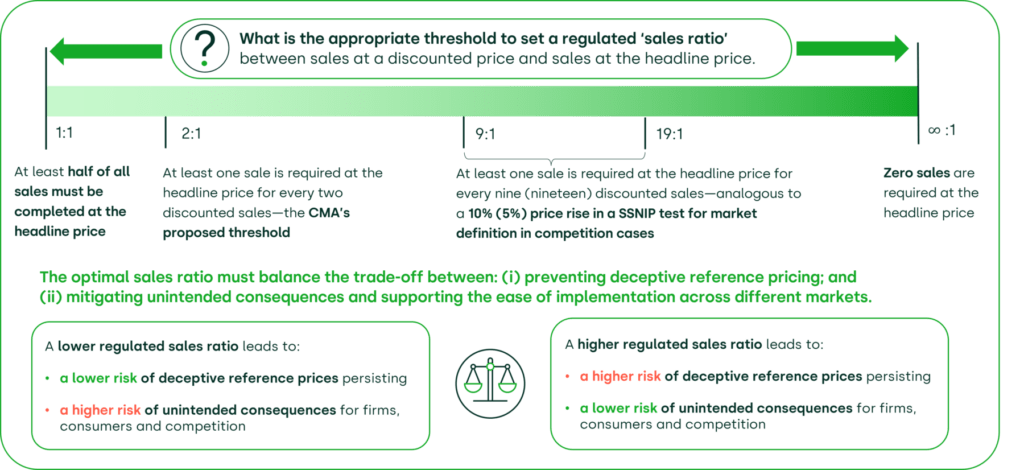
Firms offering genuine discounts may be compelled to end sales early, which creates additional pressure for consumers to buy quickly without shopping around. New entrants that rely on discounting to build market share may find it more difficult to develop a customer base, while relatively established firms that already operate with a higher baseline sales volume will be less restricted—which may weaken competitive pressure and lead to worse outcomes for consumers.
When defining the relevant market for a product in competition cases, the CMA typically considers that a 5–10% change meets the definition of a ‘small but significant and non-transitory increase in price’ (SSNIP).12 Applying a similar principle here would mean requiring at least 5–10% of sales to occur at the headline price, which translates into a sales ratio of between 19:1 and 9:1. This range could offer an appropriate balance between preventing the most egregious misleading practices and reducing the likelihood of unintended consequences.
The appropriate sales ratio would also need to be tailored to the characteristics of each market. In highly competitive markets where a large number of sellers offer similar products, and where consumers are engaged and switch rapidly in response to discounts to secure the lowest price, a discounting firm may breach the threshold more quickly than it would in less competitive environments. Products that are subject to seasonal fluctuations in demand may also be disproportionately affected by a uniform sales ratio and duration requirement.
The use of any regulated sales ratio also implies that whether a firm breaches the law will depend not only on its own pricing strategy but also on whether its competitors respond with their own discounts.
Significant open questions remain regarding the effect of reference pricing regulations on the commercial practices of firms, and the outcomes for consumers. For example, might firms use limited–quantity discounts as an insurance policy against breaching the sales ratio threshold? How should time-limited and quantity-limited offers be regulated in a way that is consistent with reference pricing, which the CMA is also scrutinising under its strengthened DMCCA powers? Should discount codes and loyalty price programmes fall within the scope of reference price regulations, and how will reference pricing rules interact with the broader set of consumer protection laws?
A further emerging consideration is the rise of agentic AI. While regulators are familiar with firms using AI to engage with customers, consumers are increasingly using AI agents to search for and purchase products on their behalf. This presents novel challenges for consumer protection enforcement, where an AI agent may filter, rank or act on price signals in ways that differ from a human consumer’s response. Whether a reference price that would mislead a human consumer has the same effect, or introduces new potential concerns, is an open question that regulators will need to consider as adoption grows.
Taken together, this analysis suggests that the CMA’s proposed volume and duration requirements represent a meaningful step towards bringing greater rigour to the regulation of reference pricing, but that their calibration is far from straightforward. The appropriate thresholds will depend on the degree of product differentiation and the number of firms selling similar products, the sensitivity of consumers to price changes, and whether demand varies based on seasonal patterns.
As the Emma Sleep case works its way through the High Court, there is a strong case for regulators to ground any assessment of discounting practices in a robust economic framework, which can support the calibration of the rules across different market contexts.
Footnotes
1 A few weeks earlier, on 22 May 2026, the retailer entered into a settlement for its use of countdown timers and false statements relating to demand for the product. Separate to the UK investigation, the Australian Federal Court ordered Emma Sleep to pay AU$15m over alleged misleading reference pricing in April 2026. While a range of conduct was examined, authorities were concerned by cases where products had only rarely been sold at the stated reference prices. See Australian Competition & Consumer Commission (2026), ‘Bedding supplier Emma Sleep to pay a total of $15m in penalties for misleading statements about sale prices’, April.
2 See Competition and Markets Authority (2024), ‘Discount and reference pricing principles: selling mattresses online’, August.
3 See Competition and Markets Authority (2024), ‘Discount and reference pricing principles: selling mattresses online’, August.
4 The CMA has noted that misleading reference pricing can distort consumer behaviour, causing them to make purchases they would not otherwise have made; see Competition and Markets Authority (2024), ‘Discount and reference pricing principles: selling mattresses online’. It is recognised that such practices can lead to harm by causing consumers to make purchase decisions which are not in their best interests; see Competition & Markets Authority (2022), ‘Evidence review of Online Choice Architecture and consumer and competition harm’, April.
5 Autoriteit Consument & Markt (2025), ‘Guidelines regarding price indications and comparisons’, September.
6 Australian Competition & Consumer Commission (2026), ‘Price displays’.
7 Competition and Markets Authority (2025), ‘Unfair commercial practices’, 18 November.
8 See Competition and Markets Authority (2015), ‘Pricing Practices in the Groceries Market, Response to a super-complaint made by Which? on 21 April 2015’, July, para. 4.66.
9 See Office of Fair Trading (2014), ‘Investigations into the use of misleading reference pricing by certain furniture and carpet businesses’, March.
10 Indeed, two of the CMA’s first round investigations in November 2025 against Appliances Direct and Wayfair which remain active—focus on the use of time-limited offers. Competition and Markets Authority (2025), ‘Appliances Direct: consumer protection enforcement case’, November. Competition and Markets Authority (2025), ‘Wayfair: consumer protection enforcement case’, November.
11 Reference to competitor pricing in determining the fairness of conduct has also been seen in the 2024 CAT judgment in BT vs CMA, regarding the pricing of landline phone services; see Justin Le Patourel v BT Group Plc & Anr [2024] CAT 76.
12 See, for example, Competition and Markets Authority (2021), ‘Draft guidance on the application of the Chapter I prohibition in the Competition Act 1998 to Technology Transfer Agreements’, April, para. 3.42; Competition and Markets Authority (2020), ‘Decision in Hunter Douglas N.V. / 247 Home Furnishings Ltd’, April. The SSNIP test reflects the idea that if a hypothetical monopolist is able to profitably raise its prices for a collection of products (or geographic areas), then that group constitutes a relevant market because there would be insufficient competitive pressure on alternative products. See Oxera (2020), ‘Two-sided market definition: some common misunderstandings’, Agenda, September.
Download

Related

No water, no growth: tackling inefficient business water demand
Water is not typically thought of as a constraint on economic growth in England. Yet that is precisely what it is becoming. Commercial growth and new developments are being turned away because there is insufficient water to serve them. Some water companies are already exercising their powers to refuse… Read More

The energy trilemma in focus: the price of dependence
Europe’s approach to energy policy has been in transition since the 2022 energy crisis laid bare the continent’s dependence on imported fossil fuels. More recently, the outbreak of war in the Middle East and the subsequent disruption to global oil and gas markets have caused further challenges. This article… Read More