
Calling time on the approach to performance incentives in water
The approach to incentivising performance in the England and Wales water sector requires substantial reform. The Independent Water Commission (IWC) has recommended rationalisation of the number of performance commitments (PCs) and a dampening of incentive rates.1 For two price reviews in a row, a significant number of water companies have raised concerns that Ofwat’s performance incentive packages were miscalibrated.
The results of AMP7 (2020–25) gave those concerns weight: against the PR19 settlement almost all companies incurred penalties on common performance measures, although rewards from bespoke measures offset some of the impact for a few companies.
The debate continued at PR24. Following the draft determinations, companies argued that targets and incentive rates, considered together, created a substantial risk of underperformance and penalties. Ofwat made changes before its final determinations, including resetting incentive baselines to reflect where the median company had actually finished AMP7. It also introduced the Outturn Adjustment Mechanism (OAM), an overall safety mechanism that was intended to adjust returns if aggregate rewards or penalties exceeded the package’s intended Return on Regulatory Equity (RoRE) exposure.
The OAM has now been triggered in the first year of its existence in AMP8. In Ofwat’s provisional assessment of outcome delivery incentive (ODI) payments for 2025/26, a staggering industry penalty of £336m has been reduced to £240m due to the OAM.2 One year is not enough to determine how the full price control will unfold, and performance can be affected by factors beyond a company’s control. Performance targets only get tougher as the regulatory period progresses, increasing the likelihood that this will not be an isolated event. But the early result raises a question: if a package is well calibrated, why is a mechanism that is designed as a backstop already needed to adjust outcomes by just under £100m in the first year of the price control?
The answer lies in how the aims of the outcomes framework have been implemented and developed over time. Key assumptions, policy choices and approaches have made calibration difficult and risks hard for the regulator to assess.
It is time to reflect on the factors that have led to this situation and, where necessary, return to the drawing board.
Before the outcomes framework
Over successive reviews, Ofwat has sought to incentivise three related but distinct things: (i) operational performance as experienced by customers and the environment; (ii) asset serviceability; and (iii) customer satisfaction. The way these objectives have been measured and rewarded has changed considerably. Understanding that history helps to identify the challenges in the current approach, and what a different approach for PR29 could look like.
Prior to PR14, operational performance, asset serviceability and customer satisfaction were assessed through separate mechanisms.
The Overall Performance Assessment (OPA) was introduced in 1999 to incentivise companies to maintain and, where necessary, improve levels of service. It measured established indicators against largely fixed standards, although there were relatively minor adjustments over time on the measures included and the level of service that was deemed acceptable.3 An opaque scoring mechanism converted performance into points and ranked companies. Modest financial incentives accrued to the best and worst performers. Companies cared about their position and sometimes argued that the common standards were harder for them to meet. Broad customer satisfaction was not directly measured.
In April 2010, Ofwat replaced the OPA with the Service Incentive Mechanism (SIM). It focused more directly on customer service, combining quantitative measures such as contacts and complaints with feedback from customers who had contacted their company. As with the OPA, an opaque mechanism converted results into company rankings. The SIM also applied financial incentives based on those rankings.4
Under serviceability assessments, companies were required to maintain their asset systems so that they remained fit for purpose over the long term.5 Measures such as water-main bursts and sewer collapses were assessed against company-specific reference levels based on historical performance. A range of expected results was established around each reference level. If performance moved outside of its usual variation, particularly if a trend emerged, Ofwat could ask the company to explain what had changed.
The assessment could consider expenditure, adverse weather, approaches to asset management and operational practices. If Ofwat concluded that asset serviceability was deteriorating because of underinvestment, significant penalties could apply, including a potential risk to the relevant capital maintenance budget. But the response was not automatic. Concerns could prompt closer scrutiny and give a company time to reverse a trend. This was a ‘supervisory’ approach that once existed in water and is now called for again: the regulator investigated the evidence and circumstances before deciding whether intervention was warranted.6
PR14: let a hundred flowers bloom
Following the recommendations of the 2011 Gray Review to pursue outcomes-based incentive regulation, Ofwat introduced the outcomes framework at PR147. The ambition was to focus on outcomes for customers and the environment, rather than simply on the outputs delivered by companies and the funding needed for this. These outcomes could also be long-term and, when first envisaged, could in theory have associated targets and incentives that spanned more than one price control.
Central to operationalising this was ‘customer engagement’, to enable companies to determine which outcomes were most important to their customers and wider stakeholders. In turn, these outcomes needed to be reflected in company business plans, in the form of a package of PCs.
Ofwat asked companies to develop their own PC measures, rather than prescribing a common set from the outset. That allowed companies to reflect the specific priorities of their customers, but it also left Ofwat with a wide variety of measures, definitions and exclusions to assess. This was not by accident—the philosophy of PR14 was that companies should take greater ownership of their plans with their customers, rather than looking to the regulator.8
There was a serious attempt to ground the incentives in economics. Expected improvements were linked to companies’ investment plans, and incentive rates were intended to reflect the value that customers placed on better outcomes. In principle, a PC would be set up to the point where the cost of further delivery matched the benefit that customers would receive.
But two features of the final determinations weakened that logic and sowed the seeds that would have long-term consequences for the success of the outcomes framework.
First, a fundamental flaw was the expectation that performance improvements would be delivered by investment in a mechanistic way. Expenditure does not translate mechanically into outcomes. A company may invest as planned yet miss a PC in a given year because of factors outside of its control, most notably the effects of weather. Conversely, favourable conditions could lead to improvement when no action had been taken. Regulatory reporting and oversight was not well suited to identifying the root causes of performance variation.
Second, after reviewing the initial proposals from companies, Ofwat introduced common targets based on an assessment of upper-quartile historical performance for some measures. Those targets were therefore no longer necessarily connected to the trending improvement in a company’s costed plan. This rendered the well-intentioned attempt to balance commitments at the point where marginal cost equalled marginal benefit irrelevant.
Ofwat’s rationale was that companies were already funded through base allowances to deliver upper-quartile performance, and so no additional funding was required to deliver these targets. Companies argued, with some justification, that this created a cost–service disconnect: upper-quartile performance was expected for cost efficiency, but costs were assessed without direct reference to performance.9 While, in the past, serviceability explicitly recognised a company’s own performance as the reference point, and the OPA required set standards to be maintained, companies were now required to rank among the best across all common outcome measures.
As upper-quartile performance was expected on each relevant common measure, rather than overall, the resulting combination represented something of a unicorn: a company that, in reality, simply did not exist.
The effects were initially limited due to important factors that would be eroded over time. Incentive rates were generally low by later standards, and upper-quartile calibration applied to only a small number of measures, leaving scope for companies to earn rewards in other areas. Nevertheless, the regulator had set a highly significant precedent: anything less than upper-quartile cost efficiency and performance was no longer good enough.
PR19: greater consistency, with broader exposure
At PR19 Ofwat began to rein in the wide variety of outcome measures and targets. The expectation that companies should deliver more stretching, sometimes upper-quartile performance became a firmer policy position, set out in the methodology, while opportunities to use bespoke measures became narrower.
In particular, Ofwat stated that using historical data to determine the upper quartile had not led to sufficient challenge.10 For three key PCs (water supply interruptions, pollution incidents and internal sewer flooding), Ofwat introduced a forward-looking upper-quartile challenge, based on comparing company business plan forecasts over AMP7 (2020–25). Even where the upper quartile was not the applied benchmark or where comparative assessment was not undertaken, targets were stretching based on other criteria, such as full compliance, a company’s best performance historically, or to deliver ambitious company or industry goals. For certain PCs, Ofwat still used targets informed by upper-quartile or median benchmarks where companies were deemed to be poor performers.
As such, companies were exposed to more performance risk. Compounding this, exclusions for factors such as severe weather were largely removed if companies had included them in their PR14 proposals, and fewer measures relied on averages to smooth variation. The result was a regime with more stretching targets across a wider range of measures and, crucially, greater year-to-year volatility in performance.
This brought greater order to the diverse landscape created at PR14. But it also meant that any systemic miscalibration could affect a larger share of the package. The relative scale of incentive rates continued to vary across companies, largely reflecting their own customer research, so the effects of the common targets were not felt equally.
Several companies argued before the Competition and Markets Authority (CMA) that the PR19 final determinations were miscalibrated. The CMA declined to intervene. However, by the end of AMP7, almost all companies were being penalised on common measures (see Figure 1). Some companies earned substantial rewards on bespoke incentives, which masked part of the wider pattern of underperformance against the measures specified by Ofwat.
Figure 1 Average annual impact of common ODIs on RoRE in AMP7 (%)
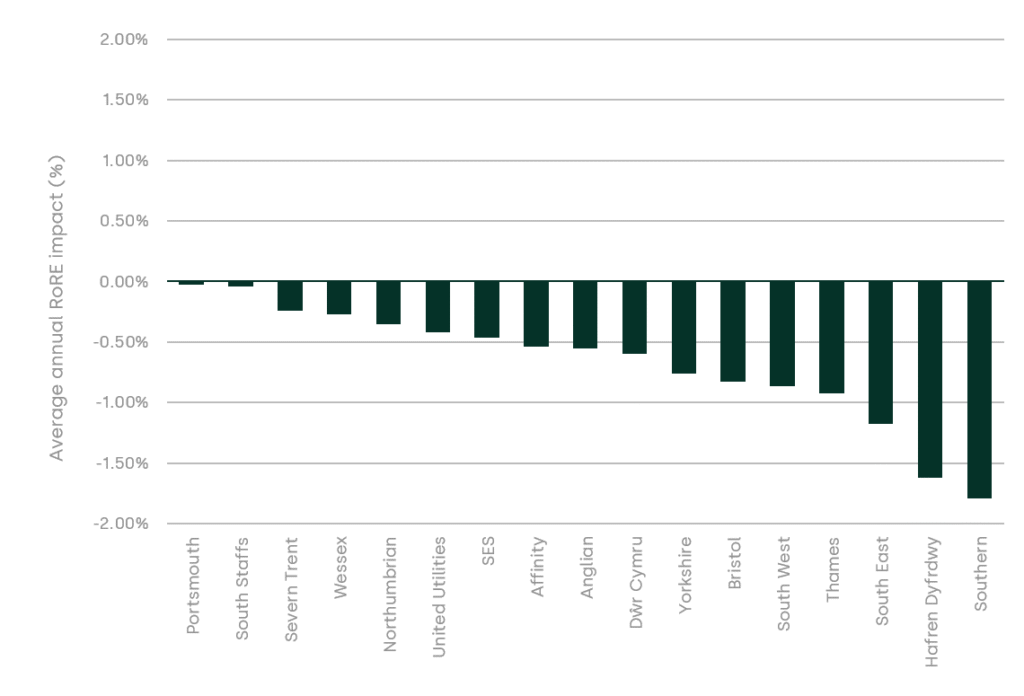
The result sharpened the debate. The more the outcomes framework relied on common targets and financial incentives, the more important it became to get the combined calibration right.
PR24: stronger incentives, and a last-minute backstop
At PR24, Ofwat continued to exert greater control over the outcomes framework, with even less focus on company specifics. It sought to standardise measures and targets, developed common incentive rates based on its own centralised research to address the wide variety of company-derived incentive rates, and severely curtailed bespoke incentives.11
However, when standardising the relative strength of incentives, Ofwat encountered difficulties in developing bottom-up incentive rates based on its own customer research. It therefore moved to a top-down allocation of RoRE, informed broadly by customer priorities.12 This top-down approach assigned a fixed amount of RoRE across an estimated range of likely performance to derive company incentive rates per PC. As a policy choice, it also made incentives stronger.13
Two factors were in play for setting targets. In the draft determinations, Ofwat moved away from the PR14 and PR19 expectation that upper-quartile performance should be a reference point for penalties and rewards for certain PCs. It instead, as a general policy, based targets on median 2025–30 forecast performance (as a minimum) across all PCs. Ofwat also retained the expectation that companies should start AMP8 from where Ofwat had assumed they would finish AMP7, rather than from the level that the industry had, on average, been able to deliver. This risked carrying forward into AMP8 the AMP7 stretch that companies had been unable to deliver. For many PCs, there remained an assumption that continuous service improvements could be delivered through base expenditure allowances.14
Ofwat had clearly sought to make concessions in the draft determinations, but companies pushed back strongly, arguing that the targets and incentive rates, taken together, created substantial expected exposure to penalties. One difficulty was that Ofwat had limited information with which to assess that risk. The Quality and Ambition Assessment (QAA) encouraged companies to propose targets that were supposed to be stretching but achievable, but penalised proposals that were not in line with Ofwat’s own expectations, often framed around full compliance or upper-quartile performance. A proposed target, however, is not the same as a forecast of likely performance. By treating proposed targets as forecasts, the risk assessment captured only the additional stretch that Ofwat applied to those proposals, rather than the gap between the targets and the company’s actual view of plausible outturns.
In its final determinations, Ofwat partially responded to companies’ concerns. Most importantly, it set incentive baselines by reference to where the median company had finished AMP7, rather than where the PR19 Final Determination had specified that it should finish. In addition, enhancement expenditure allowances were provided for some PCs, but the majority of improvement was expected from base allowances.15
In addition to attempts to address excessive risk at source, Ofwat introduced the OAM, which adjusts returns if the effect of rewards and penalties exceeds the package’s intended overall exposure.
The OAM was a pragmatic response to the difficulty of assessing the risk in advance. It was intended to guard against extreme aggregate outcomes, but it did not guarantee that the median company would receive no net penalty or reward, which was the stated aim of the incentive package. Instead, a deadband of ±0.5% of RoRE limits the extent to which the median company’s outcome can depart from zero before an adjustment applies. This avoids the most extreme consequences of miscalibration, but leaves some scope for broader downside or upside risk.
The changes were enough for most companies to accept the final determinations in the round, although some continued to challenge aspects of the outcomes package at the CMA. Unlike at PR19, the CMA found merit in some of the companies’ arguments and made adjustments this time.
With one year of the new AMP now complete, and the OAM already being required to balance overall penalties, there is a strong possibility that incentives are still not well calibrated.
What needs to change?
Reform is already on the cards. The IWC has suggested changes to performance incentives, including rationalising the number of PCs. While simplification is a reasonable first step, this alone will not fundamentally change the challenges in the current approach. Critically, the IWC recommends not just a smaller number of consistent PCs, but also that targets be set for each company taking into account its specific challenges as part of the broader recommendation for a more supervisory approach. Furthermore, incentives should be dampened to provide a more ‘narrow corridor’ that reduces variability in overall returns at risk.16
As a complement to these broader recommendations, we identify four specific factors that require attention in order to address the shortcomings of recent approaches.
First, too much of the regime relies on ex ante, in-year incentives. Many PCs represent long-term goals. Incentivising them primarily through annual financial rewards and penalties may not reflect the time needed to deliver improvement or the longer-term nature of the outcome.
Second, the regime needs to distinguish signal from noise. Measures that are influenced by factors outside of a company’s control can still be useful if trends in underlying performance can be identified and judgement applied. But, where that cannot be done reliably, it is difficult to set targets that are both stretching and achievable.
Third, the expectations for improvement funded through base allowances may be too optimistic. Base funding does not necessarily buy median, let alone upper-quartile, performance on every measure. Companies also have different structural advantages and disadvantages, which can affect their ability to improve. These factors need to be engaged with and understood.
Fourth, Ofwat and companies need a more open, two-way discussion of performance forecasts. A single point estimate cannot show the range of plausible outcomes. Companies’ forecasts should be challenged where appropriate, but the regulator should also consider them when assessing the calibration and overall risk of the incentive package.
A more holistic approach
A good performance incentive regime should deliver several outcomes: it should promote progress towards long-term goals, incentivise performance improvement, and address areas of concern. A combination of approaches could help to overcome the challenges of the current regime and advance these aims.
One option is a balanced scorecard for longer-term goals. This could allow some flexibility in the timing of progress across goals and price controls, while making significant departures from expected progress relevant to future reviews and supervisory scrutiny. It would recognise that a long-term objective may be better assessed over several years than through a series of annual rewards and penalties.
For in-period incentives, it may be challenging to have in place sufficient supervisory understanding to set individual targets for every company by PR29. Instead, Ofwat could move away from regulator-set industry targets for every measure and use comparative assessment instead. For individual measures, companies could receive fixed rewards or penalties for outperforming or underperforming their peers, broadly in line with the comparative approach used in the Customer Measure of Experience (C-Mex). This could be based either on absolute performance or on each company’s progress from its own baseline. The exposure could be calibrated such that the maximum RoRE consequence would arise only when a company lagged substantially across most measures, rather than when it underperformed on a small number of indicators. Under such an approach, there would be no need for an OAM as a backstop against overall penalties or rewards.
Finally, Ofwat could address performance concerns through a supervisory approach. Historical results and a company’s normal range of variation could be used to identify areas requiring closer examination, as in the former serviceability regime’s use of reference levels and tramlines. Ofwat could investigate the causes, assess the company’s response and, where necessary, set specific improvement expectations. Persistent failure to meet those expectations could lead to progressively greater scrutiny, with judgement-based penalties reserved for the most serious cases.
As well as the outcomes framework itself, the regulator could consider whether the full extent of financial penalties should be passed on to customers through lower bills. Lower bills do not help to resolve persistently lagging performance, but an undertaking to invest in improvement may provide companies with the means to break the cycle.
The IWC’s call to rationalise performance measures, limit companies’ risk exposure and tailor targets to company circumstances sets a clear direction for reform. But there is little time to turn these recommendations into a workable framework for PR29. There is a real risk that too much of the current outcomes framework will be carried forward, leaving its fundamental flaws unaddressed.
The industry should act now to confront the reasons why target-setting has proved so difficult over the past 15 years: uncertainty in performance, the gap between funding and expected improvement, and the challenge of distinguishing company action from external factors. PR29 needs a fresh approach that makes performance expectations stretching but achievable, and incentives effective without exposing companies to risks that they cannot reasonably manage.
Footnotes
[1] Independent Water Commission (2025), ‘Final Report’, July.
[2] Ofwat (2026), ‘Sector overview – Draft determinations of in-period outcome delivery incentives for 2025-26’, October.
[3] Ofwat (2003), ‘Updating the Overall Performance Assessment (OPA) – a consultation’, December.
[4] Ofwat (2010), ‘Annual Report 2009-10’, July.
[5] Ofwat (2009), ‘PR09/38: Serviceability outputs for PR09 final determinations’, December.
[6] Independent Water Commission (2025), ‘Final Report’, July.
[7] Defra (2011), ‘Review of Ofwat and consumer representation in the water sector’, July
[8] Ofwat (2015), ‘Reflections on the price review – learning from PR14’, July.
[9] Ofwat (2014), ‘Setting price controls for 2015-20, Final price control determination notice: policy chapter A2 – outcomes’, December.
[10] Ofwat (2020), ‘Reference of the PR19 final determinations: Outcomes – response to common issues in companies’ statements of case’, May.
[11] Oxera (2022), ‘Reflections in the water: insights on Ofwat’s PR24 draft methodology’, July. Ofwat (2020), ‘PR24 and beyond: Our reflections on lessons learnt from PR19’, December.
[12] Ofwat (2023), ‘Using collaborative customer research to set outcome delivery incentive rates’, August.
[13] Ofwat (2024), ‘PR24 Draft Determination, Delivering outcomes for customers and the environment’, July.
[14] Oxera (2025), ‘A new approach to performance and supervision in the England and Wales water sector’, report prepared for Water UK, April.
[15] Ofwat (2024), ‘PR24 final determinations, Delivering outcomes for customers and the environment’, December.
[16] Independent Water Commission (2025), ‘Final Report’, July.
Contact

Pete Duell
PrincipalContributors
Related
Related

Oxera responds to proposed changes to the UK’s competition and regulatory appeals frameworks
In July 2026, the Department for Business, Innovation, Science and Trade (BIST), then known as the Department for Business and Trade (DBT), launched a consultation on proposed reforms aimed at streamlining the UK’s competition redress, enforcement and regulatory appeals arrangements.1 Oxera provides economic advice to clients… Read More
 Podcasts

How should sustainability considerations be reflected in European Merger control?
Against the backdrop of the European Commission’s draft merger guidelines, our latest episode explores how sustainability can be given appropriate weight when assessing mergers. Helen Jenkins is joined by Simon Holmes, a Member of the UK Competition Appeal Tribunal and Visiting Professor in Law at the University of… Read More