
Oxera AI policy map – June 2026
For this fourth edition of the AI Policy Map,1 we have updated our database that tracks key national and supranational AI policy developments across the European Economic Area (EEA) and the UK. This curated collection brings together legal texts, strategy documents and other influential publications relevant to the governance of AI, based on the updated OECD AI Policy Observatory.2
Policies are categorised into the following four groups.
- ‘Law and legislation’: legally binding texts that were enacted by a legislative authority
- ‘Regulation’: legally binding texts from a government authority that did not require parliamentary legislative approval
- ‘Guidance on legal implementation’: instructions on how to implement a law, regulation, policy or other rule
- ‘Principles for trustworthy AI’: guidelines, propositions, codes of practice or other frameworks with voluntary participation
Overall, we have made the following changes in the database relative to the third edition.
- We have added three new policies for the UK, one in the ‘Law and legislation’ category and two in the ‘Principles for trustworthy AI’ category (all of which are new to the OECD database).
- In addition to the policies from the OECD data base, we added two policies for the UK, one for Portugal, and one for the EU in the ‘Guidance on legal implementation’ category.
- We have removed six policies, which all ran out in 2025 and are now inactive. These were from Austria, Croatia, Sweden and the UK.
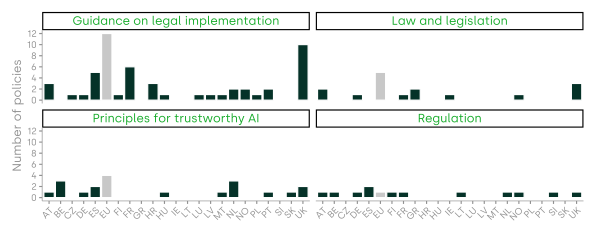
Figure 1 below shows the number of policies held by each EEA jurisdiction and the UK, broken down by policy type. Overall, ‘Guidance on legal implementation’ accounts for the largest share of policies. For example, the UK holds ten policies in this category, comparable to the 12 policies held by the EU at the supranational level. By contrast, ‘Law and legislation’ has the lowest country-level presence: beyond the EU itself, few individual countries have enacted their own AI-specific legislation. This suggests that, outside of the EU AI Act—which provides a legislative framework across all EU member states—AI remains subject to limited formal legal restriction at the national level, and that its governance is likely to remain an area of active policy debate, with the prospect of further country-level legislative provision in the years ahead.
Figure 1 Number of policies per jurisdiction for each type
A new feature has been added to the Policy Map: when exploring the details of a specific policy, users are now presented with up to four content-based policy suggestions. These suggestions allow users to quickly spot similarities in policy developments in other countries or at the EU level.
Click to show the AI Policy Map in full screen format.
* This refers to the number of AI policies featured in the map. See the methodological note for details of how they were selected.
Methodological note
The policies featured in this map are sourced primarily from the OECD.AI Policy Observatory and Global Partnership on AI, powered by the European Commission/OECD database of national AI policies/OECD.AI Policy Navigator (retrieved on 21 May 2026). This core dataset was manually supplemented with additional policies not captured by the OECD.AI Policy Navigator, based on Oxera expertise in Digital Policy & Regulation.
Our focus is on policies from the EEA and the UK, specifically those relating to AI guidance, legislation and regulation. We have then relied on the OECD’s classification, considering only those falling within the aforementioned geographic area and scope. For policies that we have added manually, as well as for the EU policies that the OECD collates without classification, we have assigned types manually according to the OECD’s categorisation.
For policies sourced from OECD.AI, we have conducted quality checks to verify their currency, relevance and completeness. Where necessary, we have updated policy titles and URLs to reflect more recent or more authoritative sources.
While we have made every effort to ensure the accuracy and completeness of the policy information presented, Oxera does not accept liability for any actions taken based on this content. We welcome notifications of missing policies, corrections, or suggestions for improvement at [email protected].
1 See the third edition from 30 January 2026, the second edition from 17 October 2025 and the first edition from 26 June 2025.
2 OECD.AI (2026), OECD.AI Policy Navigator, accessed 21 May 2026.

Related

Oxera AI policy map – October 2026
For this fifth edition of the AI policy map,1 we have updated our database that tracks key national and supranational AI policy developments across the European Economic Area (EEA) and the UK. We have also introduced a new interface to make the map clearer and easier to… Read More

Calling time on the approach to performance incentives in water
The approach to incentivising performance in the England and Wales water sector requires substantial reform. The Independent Water Commission (IWC) has recommended rationalisation of the number of performance commitments (PCs) and a dampening of incentive rates.1 For two price reviews in a row, a significant number of… Read More