
From uncertainty to causation: a valuation perspective on life sciences disputes
How do you value a product that may never reach the market? How do you distinguish commercial opportunity from scientific possibility? How do you assess loss in markets shaped by regulation, reimbursement and patient behaviour?
These are just some of the valuation questions that arise in life sciences disputes. From discovery through to commercialisation, the value of a life sciences product is shaped by clinical risk, regulatory approval and finite periods of market exclusivity. These features, combined with the sector’s long development timelines and high commercial stakes, make the valuation of life sciences assets—and the quantification of losses arising from disputes—materially more complex.
Drawing on Oxera’s experience in recent cases, we examine some of the key valuation challenges in life sciences disputes. As the examples discussed in this article illustrate, these disputes rarely turn on the choice of valuation methodology alone. More often, they depend on whether the underlying assumptions reflect the scientific, regulatory and commercial realities of the sector.1
Valuing uncertainty
The valuation of products still in development presents some of the most challenging issues in life sciences disputes. A recent case in which Oxera provided expert advice illustrates why. The dispute concerned a research agreement under which a university was commissioned to conduct a pre-clinical study into the use of a patented liquid aspirin formulation for treating brain cancer.2 The study itself was commissioned for a fairly modest sum. Yet, following the retraction of the published research, the patent owner sued the university for damages exceeding £100m. It alleged that the need to repeat the study delayed the drug’s potential commercialisation, thereby shortening the period of market exclusivity and reducing the royalties that it could otherwise have earned from licensing the patent to a hypothetical licensee.
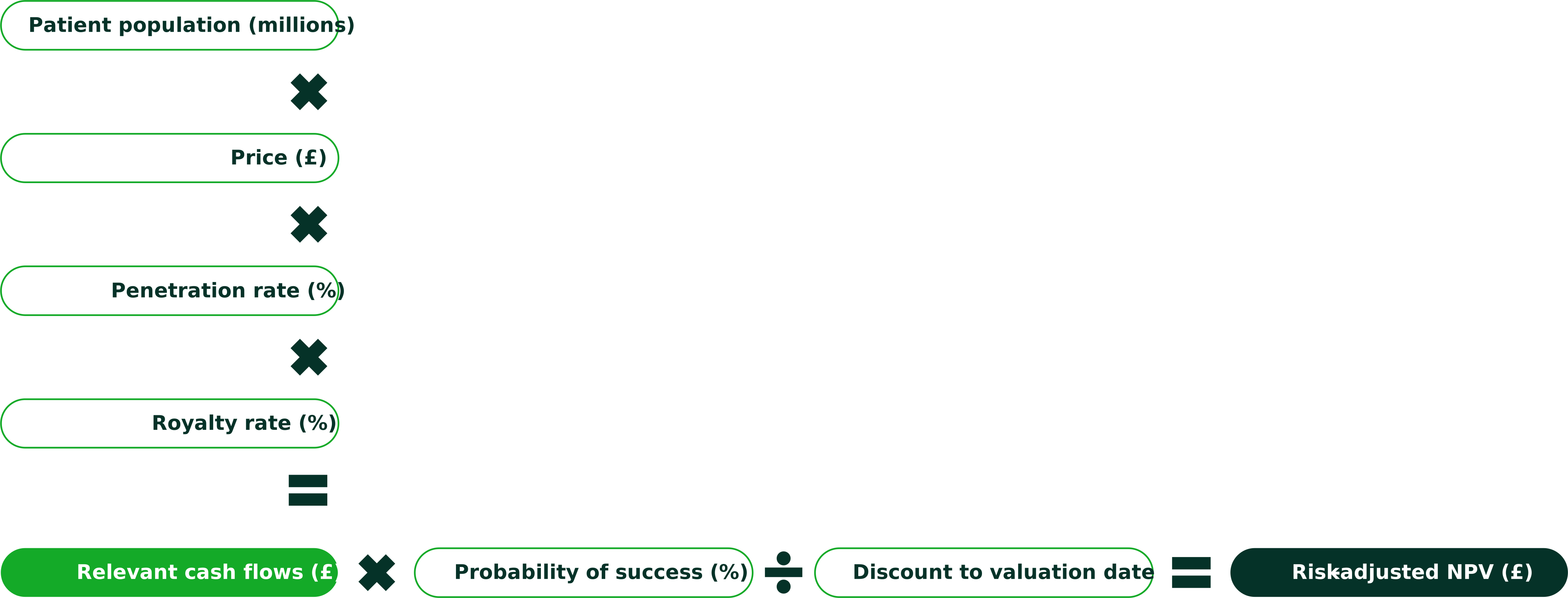
Both parties’ valuation experts adopted the risk-adjusted net present value (rNPV) method to estimate the lost royalties. At a high level, the rNPV method projects future cash flows, adjusts them for the probability that the product will successfully progress through development and regulatory approval, and discounts the probability-weighted cash flows back to the valuation date. In this case, estimating the future cash flows to the patent owner required a series of assumptions about the size of the target patient population, the likely price of the drug, the expected market penetration, and the royalty rate that a hypothetical licensee would have been likely to agree to pay. As the product remained at the pre-clinical stage, the valuation also required an assessment of the probability that the product would successfully progress through clinical development and obtain regulatory approval, together with the appropriate discount rate to reflect the time value of money and the risks associated with those future cash flows. These steps are illustrated in Figure 1 below.
Figure 1 Stylised illustration of the rNPV method
While the two experts adopted the same valuation method, they arrived at valuations that differed by an order of magnitude. This divergence arose from differences in the underlying assumptions, including the market evidence used to inform them. For example, there was no factual evidence regarding the formulation’s commercial potential or likelihood of success. Both experts therefore looked to market evidence on comparable products to inform these assumptions.
However, selecting appropriate comparators in the life sciences sector is rarely straightforward. Unlike in many other industries, life sciences assets can be highly differentiated: products that appear similar may differ materially in their mechanism of action, therapeutic indication, stage of development, and commercial strategy. As a result, identifying a truly comparable transaction is often very difficult. The expert must balance competing considerations. A small set of potentially comparable transactions may offer greater economic relevance but limited statistical robustness, while a broader dataset may provide more observations at the expense of comparability.
A further difficulty is that the observable market evidence is often subject to survivorship bias. Market valuations or licensing transactions are more commonly observed for products that have successfully progressed through development, whereas observable market evidence for assets that reached only a much earlier stage is relatively scarce. Indeed, pre-clinical research is often characterised by what is commonly referred to as the ‘valley of death’, as illustrated in Figure 2 below. While early research may produce encouraging scientific results, many promising compounds never progress to clinical trials because of the significant scientific, regulatory, financial and commercial challenges involved. This is an important consideration when interpreting observable market evidence to inform the valuation of early-stage assets.
Figure 2 Stylised illustration of the drug development process

Notably, in the liquid aspirin dispute, much of the claimed loss did not relate to brain cancer—the subject of the research agreement—but to the potential use of the formulation in treating other cancers, for which no supporting studies existed at the time of the alleged breach.
This raises a fundamental valuation question: how should future commercial opportunities be assessed where the development potential has yet to unfold? Answering this question requires valuation experts to construct a counterfactual scenario based on the scientific, regulatory and commercial evidence available at the valuation date. This includes considering whether a hypothetical licensee would have invested in further development and, if so, which therapeutic indications or commercial opportunities it would have regarded as sufficiently promising to justify that investment at that point in time.
For example, in the liquid aspirin dispute, our opinion was not that the formulation could never have been developed for non-brain cancer indications. Rather, based on the technical and commercial evidence available at the valuation date, we determined that a hypothetical licensee would not have attributed meaningful value to those opportunities at that date. The court accepted this distinction, concluding that losses associated with non-brain cancer indications were ‘too remote to be recoverable’.3
Attributing loss
While disputes involving products still in development are dominated by uncertainty, disputes involving established products present a different set of valuation challenges. One recent matter on which Oxera provided expert advice concerned the supply of an active pharmaceutical ingredient (API) used to manufacture a generic medicine. Quality issues affecting the API led to a market-wide supply disruption, and a generic pharmaceutical company sought substantial damages from the API manufacturer for the profits allegedly lost on sales of the affected generic product.4
At first sight, quantifying the loss appeared to be straightforward: compare the sales of the affected product in the actual world (or the ‘factual scenario’) with those that would have been achieved absent the supply disruption (or in the ‘counterfactual scenario’). However, the regulatory and commercial realities of the pharmaceutical sector made this assessment considerably more complex.
The API supply disruption affected the market as a whole rather than the claimant alone, as it constrained the supply of the generic medicine across multiple generic manufacturers. As a result, when the claimant was unable to supply its product, patients could not simply switch to another generic manufacturer of the same medicine. Instead, many were switched to alternative treatments, including different generic medicines or the branded version of the affected drug, with the extent of substitution varying across jurisdictions depending on reimbursement policies and clinical practice. When supply constraints eased, many patients did not return to the original generic medicine because they were tolerating the alternative treatments well. As a result, the reduction in demand for the affected product persisted beyond the period of supply disruption.
This raised an important question of causation: to what extent should the persisting difference between the factual and counterfactual sales of the affected product be attributed to the alleged breach, rather than to the subsequent changes in patient and prescribing behaviour triggered by that breach? From an economic perspective, the expert can analyse market data on how patient and prescribing behaviour evolved following the supply disruption and estimate the extent to which those changes affected the persisting difference between the factual and counterfactual sales. Whether those persisting losses are legally attributable to the alleged breach is ultimately a matter for the court or tribunal.
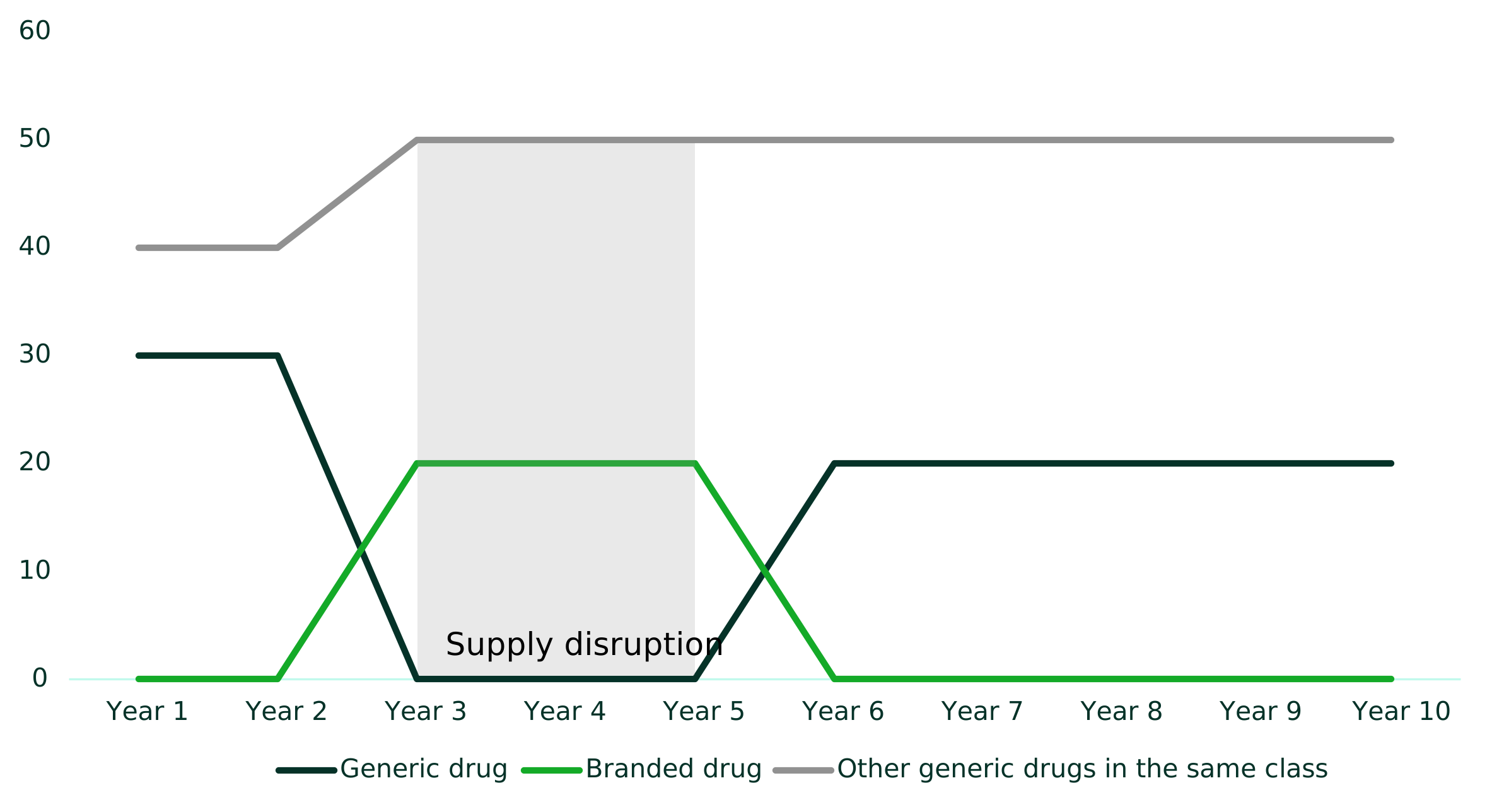
Another important issue in this case concerned mitigation and the assessment of overall economic loss. The reduction in sales of the affected product was accompanied by an increase in sales of substitute medicines within the claimant’s portfolio that were used to treat the same indication, as shown in Figure 3 below. This raised the question of whether the claimant’s loss should be assessed by reference to the affected product alone or to its wider product portfolio. From an economic perspective, assessing the loss by reference to the affected product alone can overstate the claimant’s overall economic loss if some of the displaced demand is captured elsewhere within its portfolio. In this case, the tribunal ultimately did not need to resolve this issue because it found that the API manufacturer was not liable.
Figure 3 Illustration of the impact of supply disruption on the claimant’s portfolio
Common principles across a diverse sector
Life sciences disputes present valuation challenges that are distinctive in both their complexity and their diversity. As the case studies discussed in this article illustrate, those challenges may differ depending on whether the dispute concerns a product in development or an established commercial product. Yet a common thread runs through both: valuation depends not only on the choice of methodology, but on developing economically coherent assumptions that reflect the scientific, regulatory and commercial realities of the life sciences sector.
While the precise assumptions will depend on the facts of the case, several broad principles are likely to apply.
- The first is that the assumptions should reflect the high-risk, capital-intensive nature of drug development. A promising technology does not necessarily attract funding, secure a licensing agreement or progress through clinical development. Investment decisions in the life sciences sector are influenced by a range of factors, including expected returns, competing pipeline assets, capital constraints and strategic priorities.
- The second is that the assumptions should be internally consistent. For example, assumptions about market share cannot be divorced from assumptions about pricing or reimbursement policies. A valuation that combines individually plausible assumptions without considering these interdependencies risks becoming economically incoherent.
As the life sciences sector continues to grow and evolve, disputes are likely to become more common. Valuation methodologies can provide the analytical framework to quantify value or loss, but their application requires careful judgement and a detailed understanding of the scientific, regulatory and commercial context in which the dispute arises.
Footnotes
1 The views expressed in this article are those of the authors alone and do not represent those of Oxera.
2 Innovate Pharmaceuticals Limited v University of Portsmouth Higher Education Corporation [2024] EWHC Technology and Construction Court, Case No: HT-2021-000478. Oxera advised the University of Portsmouth in these proceedings.
3 Innovate Pharmaceuticals Limited v University of Portsmouth Higher Education Corporation [2024] EWHC TCC, para. 333 (1).
4 Oxera advised the API manufacturer in this dispute.

Related

Calling time on the approach to performance incentives in water
The approach to incentivising performance in the England and Wales water sector requires substantial reform. The Independent Water Commission (IWC) has recommended rationalisation of the number of performance commitments (PCs) and a dampening of incentive rates.1 For two price reviews in a row, a significant number of… Read More

Oxera responds to proposed changes to the UK’s competition and regulatory appeals frameworks
In July 2026, the Department for Business, Innovation, Science and Trade (BIST), then known as the Department for Business and Trade (DBT), launched a consultation on proposed reforms aimed at streamlining the UK’s competition redress, enforcement and regulatory appeals arrangements.1 Oxera provides economic advice to clients… Read More