
Public control: a new direction for essential services?
Public control is back on the agenda. But what will it mean in practice for essential services, and for those who invest in them and run them?
The UK Prime Minister, Andy Burnham, has placed public control as part of his government’s strategy for economic and national renewal. The government’s ambitions span water, energy, transport and housing—but ‘public control’ could mean anything from stronger local oversight to full public ownership or competition from new public companies. The government’s next steps will shape investment, risk, competition and accountability across each sector.
What does the government really mean by ‘public control’?
Andy Burnham, Labour Party Conference 2026
The Prime Minister is seeking a greater public role over essential services such as water, energy, transport and housing. This could mean stronger local accountability whereby mayors are given new regulatory powers or greater powers to hold utilities to account. It could mean public ownership of existing utilities, or the establishment of new public companies to compete with private utilities.
Any move to public ownership will bring practical fiscal challenges. Changes to the fiscal rules would allow the government to count spending on infrastructure or equity stakes in companies as assets to be offset against borrowing costs. However, the scale of government borrowing would still remain a barrier.
What’s driving the push for change?
The government’s case is that privatisation has failed to ensure that essential services are affordable, accountable and run in the public interest. Burnham has linked the model to excessive executive remuneration and dividends and costly debt, arguing that these costs ultimately fall on billpayers. He has also pointed to poor performance, including sewage pollution, and slow delivery, such as delays in connecting businesses to the electricity grid.
The implication is that the existing regulatory framework has not been sufficient to secure the outcomes that the government wants from privately owned utilities. That does not necessarily mean that independent regulated private provision of services has failed in principle, but it does imply that the government believes that independent regulation alone may not be enough.
The argument above represents the government’s case for change, not proof that public control will automatically improve performance or lower bills. Outcomes will depend existing underlying levels of performance and existing public control mechanisms, as well as on the model chosen and how the resulting ownership, regulation, investment and accountability are designed. This is particularly important given the scale of investment needed across sectors, the reliance on private finance to deliver much of it, and the urgency of meeting the UK’s climate goals.
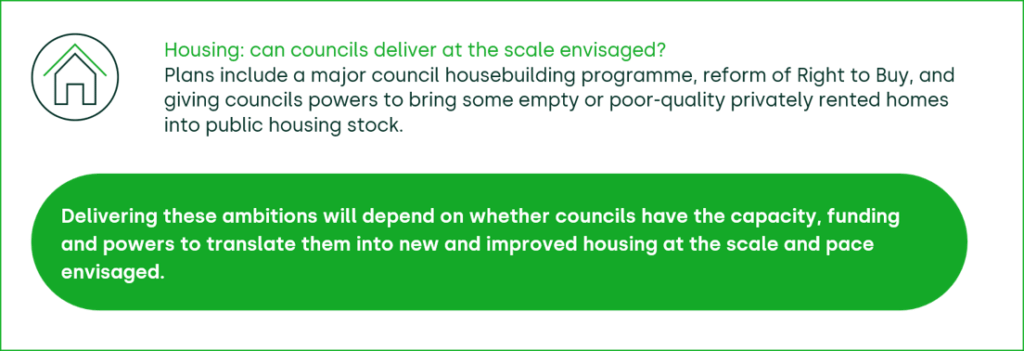
One ambition, four different sectors
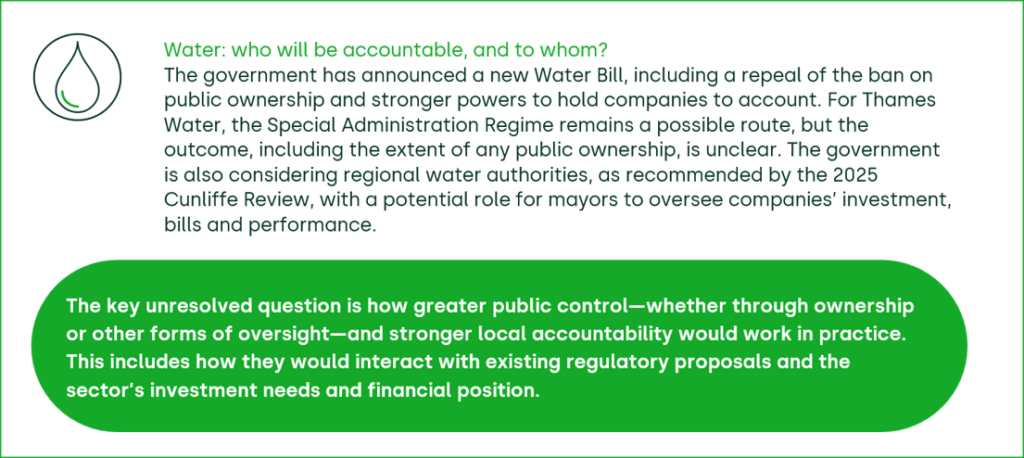
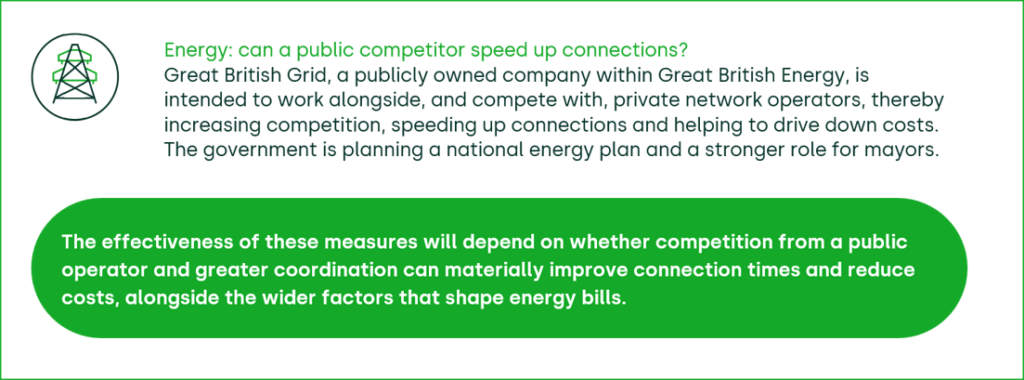
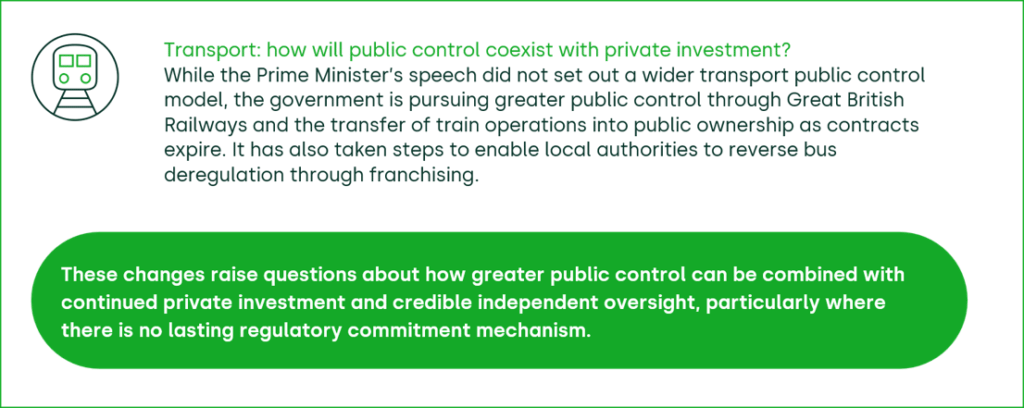
From ambition to action: what happens next?
Watch this space: the government has established a Public Control Taskforce chaired by First Secretary of State, Louise Haigh, to examine how public control could work across sectors, including water. The Prime Minister has also announced that a ten-year plan for Britain will set out the government’s wider approach. This is expected to provide more detail on the intended models, powers, funding and sequencing, and is due to be published before the end of the year.
The Oxera lens: choices, trade-offs and delivery
The question for boards and investors is no longer just whether public control is coming, but what form it will take and what that will mean.
Over the coming months, Oxera will examine this evolving agenda through three connected topics.
- The case for public control: what economic problems is it meant to address? What does the evidence tell us about the relationship between ownership and performance, and when can private provision and regulation deliver public-interest outcomes?
- The available models: what forms could greater public control take, from stronger regulation and local accountability to public ownership? What are the trade-offs for investment, risk, incentives and accountability?
- Implementation: how could each model work in practice? What would it mean for financing, regulation, competition and governance, and what lessons can be drawn from experience in other sectors?
Oxera will continue to examine these developments sector by sector, drawing on our experience in water, energy, transport and infrastructure regulation to assess the options, trade-offs and practical implications.

Related

Points of contention: what Burnley v Everton tells us about potential future compensation claims
In February 2023, the Premier League referred Manchester City FC to an independent commission over alleged breaches of the competition’s financial rules.1 The allegations concerned the accuracy of the club’s financial reporting, compliance with Premier League and UEFA spending limits, and co-operation with the League’s investigation. Manchester… Read More

Oxera AI policy map – October 2026
For this fifth edition of the AI policy map,1 we have updated our database that tracks key national and supranational AI policy developments across the European Economic Area (EEA) and the UK. We have also introduced a new interface to make the map clearer and easier to… Read More